
 Mattress Toppers
 Bamboo Mattress Toppers
 Latex Mattress Toppers
 Memory Foam Mattress Toppers
 Mattress Protectors
 Accessories
Are Mattress Toppers Good for Side Sleepers?

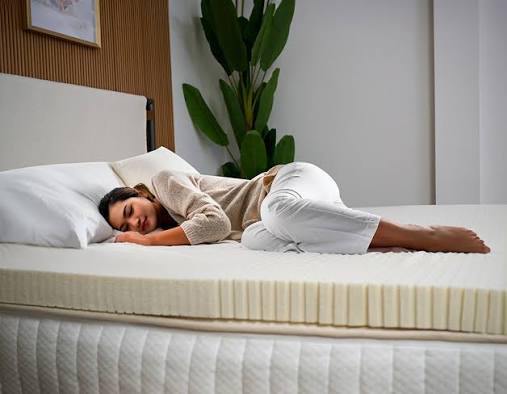
Yes, arguably more than for any other sleep position. Side sleeping puts your body in the worst possible spot to tolerate a mattress that has gone firm or never suited you in the first place, which is exactly why a topper tends to make the biggest difference for this group. Here is why side sleepers feel a mattress more intensely than everyone else, and what actually matters when choosing a topper to fix it.
Why Side Sleepers Feel a Firm Mattress More Than Anyone Else
Lying on your side sends your weight through two narrow points, your shoulder and your hip, rather than spreading it across a broad, flat area the way back or stomach sleeping does. A firm surface pushes back hardest exactly where your body has the least natural padding to absorb it. That is not a flaw in the mattress. It is simply a mismatch between a flat, even surface and a body that is not making flat, even contact with it.
What Actually Matters in a Topper for Side Sleeping
Three things decide whether a topper actually helps, and everything else is secondary.
The material needs to contour rather than resist, letting your shoulder sink in gradually instead of meeting firm resistance almost immediately. There needs to be enough thickness that you do not compress straight through the topper and hit the firm mattress underneath anyway, which defeats the purpose entirely. And the cover needs to move with the material rather than against it, since an overly tight or heavily reinforced cover can make even a genuinely soft foam feel stiff on top.
Does Material Choice Change More for Side Sleepers Specifically?
Memory foam tends to be the strongest starting point. It softens under body heat and pressure, moulding closely to the shoulder and hip rather than offering a generic shape, which is exactly what those two pressure points need most.
Latex is springier and pushes back more, so it does not cradle a shoulder quite as closely as foam does. It still works well for side sleepers who run hot or want an easier time changing position through the night, just with slightly less deep contouring.
Feather and thin fibre fill feel plush at first but compress fast and lose loft within months. For a side sleeper specifically, that is a real problem, since the shoulder and hip are exactly the areas taking the most pressure, and they are the first spots to flatten out once the fill starts to give. Our full breakdown in which kind of mattress topper is best covers how each material behaves in more depth.
Why Heat Builds Up Faster for Side Sleepers
Side sleeping puts more of your body in direct contact with the topper at once, shoulder, arm, hip, and often part of the torso, compared with the flatter contact area of a back sleeper. That means heat has less room to escape, so a breathable or gel infused option matters more here than it does for other sleep positions. Bamboo or a cooling memory foam option both address this directly.
How Thick Should a Side Sleeper’s Topper Be?
Generally 7 to 10cm. Anything thinner risks bottoming out, where your shoulder compresses straight through the material and you end up feeling the firm mattress underneath regardless, which means you have paid for a topper without actually getting the benefit. Our full guide on what thickness mattress topper is best covers how that range compares across sleep positions if you share a bed with someone who sleeps differently.
Does the Cover Matter as Much as the Fill?
More than most buyers expect. A soft, contouring foam underneath a stiff, heavily reinforced cover will not feel soft once you are actually lying on it. This is one of the details worth checking on the product page before you buy rather than discovering it once the topper has already arrived, alongside the thickness and material specs covered above.
If Pain Is the Real Issue, Not Just Position
Everything above is about general comfort and pressure distribution for side sleeping. If you are dealing with ongoing back or hip pain rather than general pressure discomfort, that is a slightly different question with its own considerations, which we cover specifically in can a mattress topper fix back pain.
FAQs
What thickness works best for side sleepers?
Generally 7 to 10cm. Thinner options often let your shoulder compress straight through to the firm mattress underneath, losing most of the pressure relief you bought the topper for.
Is latex or memory foam better for side sleeping?
Memory foam usually wins for pure pressure relief, since it contours more closely around the shoulder and hip. Latex is a solid alternative if you run hot or want an easier time changing position through the night.
Can a topper cause more pressure for side sleepers if it’s the wrong type?
Yes, if it is too thin or too firm for your body weight. A topper that does not let your shoulder sink in properly can concentrate pressure almost as much as having no topper at all.
Do side sleepers need a softer mattress overall, or does a topper solve it?
A topper solves it in most cases, provided the mattress underneath is still structurally sound. It only falls short if the mattress itself has sagged or lost its support entirely.
Sleep Better on Your Side at Mattress Toppers AU
Side sleeping is the position that benefits most from getting the topper right, and Mattress Toppers AU stocks memory foam, latex, and bamboo options in the 7cm and 10cm range built for exactly this. Browse the full range and give your shoulders and hips the cushioning they have been missing.